

10 min read
Our son was about a year old when the fever came. It ran high for two days and then, in the middle of the night, his whole body went hot in a way that scared us properly.
We called his doctor. She picked up anyway, and she told us to get him to the hospital now. Later that same night she came to the hospital herself, just to look at him.
If it is not your child in the hospital but a grandparent who is ill, that is a different conversation and I wrote about it separately.
I remember carrying him in for a scan. I’d taken his shirt off, and he said, “Daddy, it’s so cold, I’m shivering, it’s hard for me, it’s hard.” He barely had words yet and those were the ones he found. My wife cried. Her mother and her sister came and sat with us. Another doctor arrived, treatment started, and inside a day he was fine.
He doesn’t remember any of it. I remember all of it.
Key Takeaways
- Read the book before the appointment, not in the waiting room. The point is knowing what happens next.
- Books that show the equipment help most. Most of the fear is unfamiliarity, not pain.
- Don’t promise it won’t hurt. Promise you’ll stay.
- Stories where a friend takes care of someone sick work for the other side of it too, when your child is the one watching.
- Our Rustle the Fox came from that hospital night, with the doctor written in as Grand Fox.
What a child is actually scared of
It usually isn’t the needle. That’s what we assume, because that’s what we’d be scared of.
For a small child it’s mostly not knowing what comes next. A strange room, a stranger who wants to touch them, a machine that makes a sound, and a parent who’s clearly tense about something. They read your face before they read the room. If you’re braced, they brace.
So the useful thing a book does here is boring and specific. It shows the room. It shows the light in the ears, the cold thing on the chest, the paper on the table that crinkles. None of that is frightening once you’ve seen it in a story first, sitting on the sofa, days ahead of time.
Which is why the timing matters more than the title. A book on the morning of the appointment is damage control. The same book on a calm Tuesday night is preparation.
Books for kids going to the doctor
1. Curious George Goes to the Hospital by Margret and H. A. Rey
George swallows a puzzle piece and ends up in the hospital. He drinks barium, gets an x-ray, meets a nurse named Carol, and stays the night on the children’s ward.
It was written in 1966 specifically to make hospital stays easier for children, and you can feel that intent in it. Everything gets shown and named. It’s the one I’d pick if an actual admission is coming, rather than a checkup, because it covers the overnight part that most books skip. If it is your child staying in and somebody else at home missing them, books for a child whose parent is away cover the other side of that night.
2. Bear Feels Sick by Karma Wilson, illustrated by Jane Chapman
Bear is sniffly and achy and can’t sleep, and too rotten to play. Mole, Hare, Mouse and the rest look after him in his cave with tea and lullabies until he comes right. Then, the moment he’s better, all of them come down with it.
The rhyme is lovely to read aloud, which matters when you’re on the fourth reading. And it quietly teaches the other half of illness, the part where you’re the one doing the caring. Good from about three.
3. Llama Llama Home with Mama by Anna Dewdney
Llama Llama is too sick for school, so Mama looks after him all day. Then Mama catches it, and Llama Llama has to work out how to look after her.
That flip is the whole reason this book is on the list. A child who’s been the patient gets to imagine being the helper, and most of them love it. It’s also the most familiar scenario here, an ordinary sick day at home rather than anything medical.
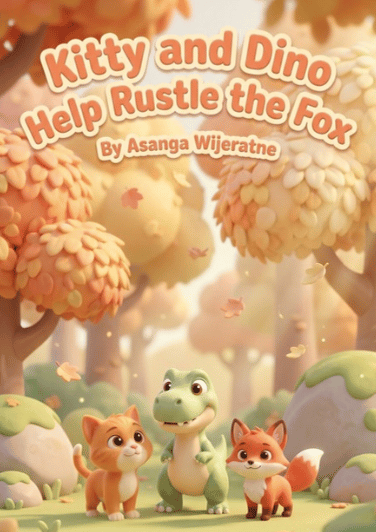
4. Kitty and Dino Help Rustle the Fox
This is the one from that night.
Rustle’s cubs are sick and they aren’t getting better. So he asks Kitty and Dino for help, and the three of them set out to find Grand Fox, who has the medicine that can cure them. They make the journey, they get it, and the cubs recover.
Grand Fox is that doctor. The one who answered the phone in the middle of the night, and then turned up in person. When I sat down to write a story about a parent frightened for a sick child, I didn’t have to invent the feeling, and I didn’t much want to. I just moved it into a forest and gave it a happier, faster ending than the one we lived through.
If your child is the one who’s been unwell, or is about to be, this is a gentle version of it where somebody knows what to do.
5. Kitty and Dino Help Bently the Goat
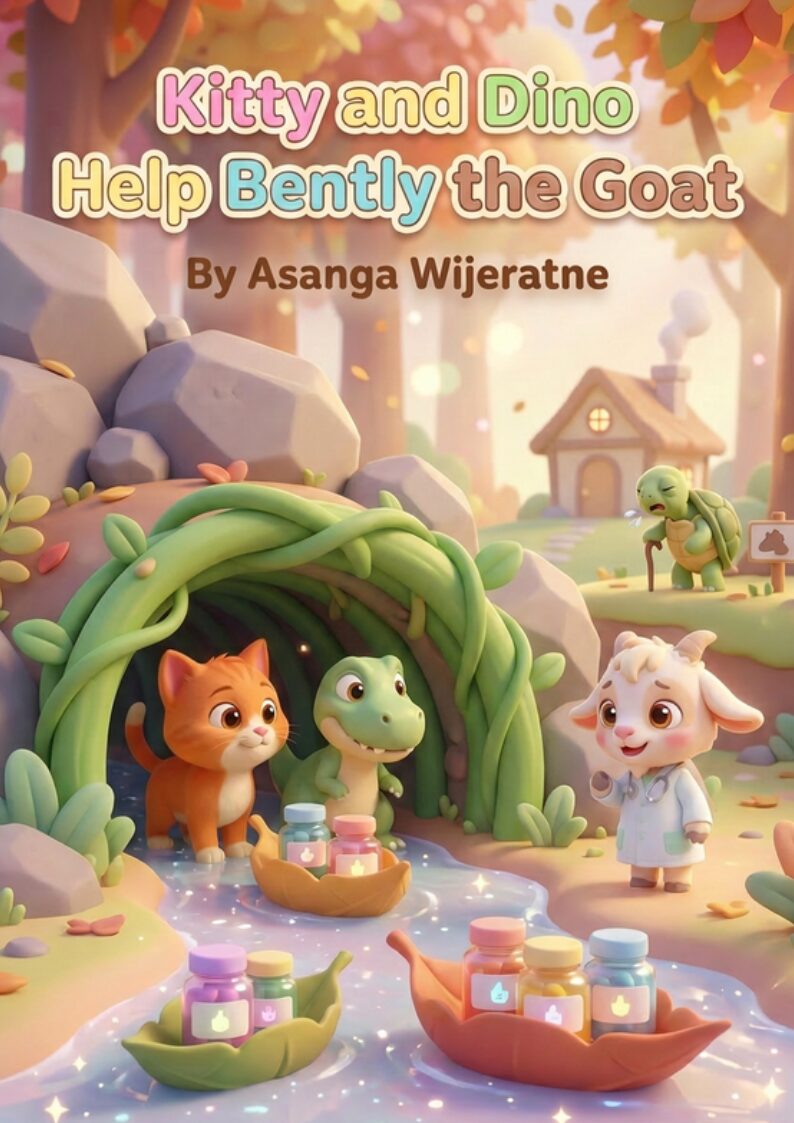
Bently is a white goat in a doctor’s coat with a stethoscope round his neck, and he is the doctor for every animal in the forest.
A rockslide has buried the mountain path, and his clinic is on the far side of it. Sick animals are waiting over there for medicine, his supplies are sitting in jars and boxes on the wrong side, and it all has to get through by sunset. Old Turtle needs his most. He has a bad cough.
Kitty tries her wind and it only shifts the small rocks. Dino tries his vines and there are simply too many. So they have to think of something better, together. That pattern runs through the whole series, and I wrote about the picture books about teamwork that do it best.
I mention this one because it does something the others on this list don’t. It puts the doctor on the child’s side of the story. He isn’t the stranger with the cold stethoscope. He’s the one who’s worried about getting to you.
What helps besides the book
Say what will happen, plainly and in order. “The doctor will look in your ears, then listen to your chest, then we go home.” Children handle a lot when they know the shape of it. Vagueness is what leaves room for imagination to fill in.
Don’t promise no needles. It’s tempting and it costs you the next visit. If you don’t know, say you don’t know, then say the true thing instead: it might pinch for a second, and you will be right there, and you are not leaving.
Let them bring something. A small toy that can also get checked over. It gives them a job and something to hold, and doctors are almost always game to examine a bear first.
Bring something for the wait, too. Most of the appointment is sitting still in a room with nothing happening, which is harder for a small child than the exam itself. If waiting is the part your child struggles with generally, these books about patience work on exactly that muscle.
Afterward, tell them what they did. Not “you were so brave,” which is a bit abstract. “You sat still the whole time even though you didn’t want to.” That’s the version they can use next time. It’s the same idea we lean on for helping kids face fear generally, and for the days that don’t go their way.
One last thing
The thing I didn’t expect, that night in the hospital, was how much of it was about us and not him. He was uncomfortable and then he was better. We were the ones who carried it around afterward.
Kids are often steadier than we assume, and mostly they’re taking their reading from our faces. Which is worth knowing before the appointment, because the calmest thing in that room is the thing that helps most, and it isn’t the book.
The book just means nobody walks in cold.
FAQ: Books About Going to the Doctor
From the Kitty & Dino bookshelf
Gentle picture books that bring this to life for ages 3–8:


Pingback: Children's Books About Animals for Ages 3-8 | Kitty & Dino
Pingback: Children's Books About a Sick Grandparent | Kitty & Dino