
9 min read
“I can’t do this.” My son went through a stretch where that sentence arrived before the thing had a real chance. He’d get discouraged, and that was that.
If that’s your house right now, here’s the short answer. The picture books that help are the ones where the character fails first and keeps going, and it helps a lot to match the book to what your child actually says when they quit. “I can’t” needs a different story than “it’s not perfect.” So that’s how this list is sorted.
Key Takeaways
- “I can’t” is usually a feeling talking. Tiredness, or a recent failure, and a small child doesn’t know which.
- Pick the book by the words your child uses when they quit. Each one below is filed that way.
- Look for stories where the first try goes wrong. The happy ending only teaches something if the character had to work for it.
- Telling a young child to push through rarely lands. Watching a character do it often does.
- Our own book on this is Pippin the Pig, ages 3 to 8, free with Kindle Unlimited.
What “I can’t” usually means
You know the moment. One wobbly line and the whole drawing is apparently ruined forever.
When my son refuses something, the first thing I try to do is work out what the feeling is. Kids feel it long before they can name it. All they know is that they don’t want to do the thing. Once the feeling has a name (“you’re tired,” “that didn’t work last time and it stung”), the next step is a lot smaller.
Two feelings show up most. Being worn out is one. The other is a fresh failure, the kind that makes a second try feel pointless. A book can’t fix tiredness. The second one, though, is exactly what a story is good at.
Picture books sorted by what your child says when they quit
When they say “I can’t”
The Magical Yet by Angela DiTerlizzi, illustrated by Lorena Alvarez. A girl falls off her bike and swears she’ll never ride again. Then she meets the Yet. Plenty of parents already use that little word, turning “I can’t” into “I can’t yet.” This book gives it a character your child can point to.
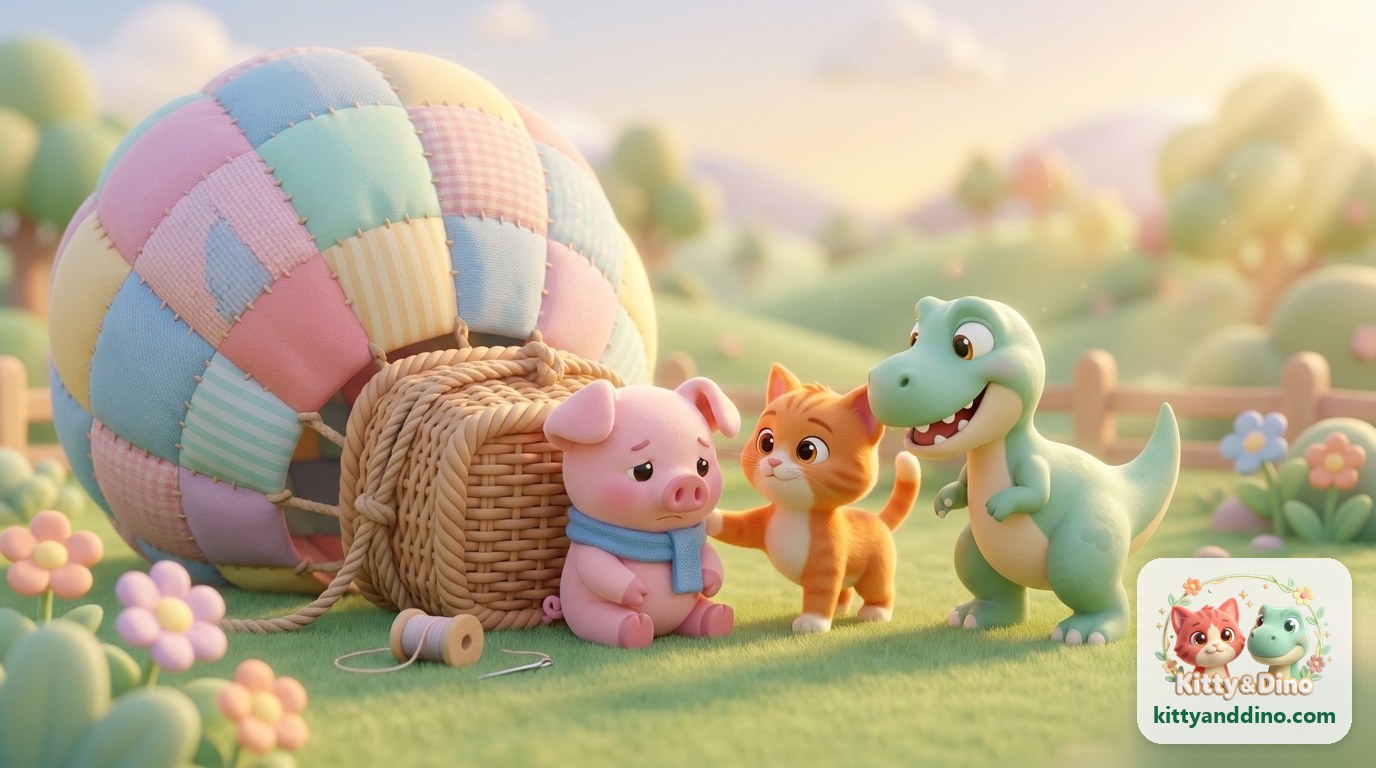
Kitty and Dino Help Pippin the Pig. This one’s ours, so weigh it accordingly. I wrote it after that stretch of “I can’t do this.” It made me think of “when pigs fly,” the thing people say about something impossible. In Sinhala we have our own version: when a tortoise grows feathers. In the book, Pippin says it himself: “But pigs can’t fly.” Dino’s answer is “Today you can.” They sew a balloon together, and the first try doesn’t work at all. It won’t float. So they check Pippin’s book again, work out that a balloon needs hot air, and try again. By the end he’s up over the farm and the river. It’s free to read with Kindle Unlimited, or you can get it on Amazon.

Kitty and Dino Help Pippin the Pig
When they say “It’s not perfect”
The Most Magnificent Thing by Ashley Spires. A girl sets out to build the most magnificent thing. It keeps coming out wrong. She gets mad and walks away from it for a while, then comes back. What she ends up with isn’t perfect, and it’s exactly what she wanted. That last part is the lesson. It’s on our list of picture books that encourage imagination too.
The Girl Who Never Made Mistakes by Mark Pett and Gary Rubinstein. Beatrice Bottomwell has never made a mistake, and keeping that record is the whole weight she carries around. Then she makes one. The relief in the book is the point, and perfectionist kids tend to feel it.
When they say “I ruined it”
Beautiful Oops! by Barney Saltzberg. Every page is a mistake on purpose: a tear, a spill, a smudge, and each one turns into the start of something new. It’s the fastest way I know to show a small child that a mistake can be the place a picture starts.
Kitty and Dino Help Milo the Monkey. Ours again, so weigh it that way. Milo loves inventing fruit mixes, and his newest one has magic he didn’t expect: everything it touches floats away. He spills it, half the jungle starts drifting into the sky, and his first words are “I made a big mistake.” Nobody scolds him. Kitty and Dino ask how his fruit works, try rain first (it only half helps), then ask if he has any of the first fruit left, and that’s what brings everything back down. His takeaway is the one you’d hope for: trying new things is good, he just wants to be a bit more careful next time. It came from watching my son tip five puzzles into one pile and sit there stuck, until we sorted the pieces by color and fixed them one at a time. Free with Kindle Unlimited, or get it on Amazon.
If the mistake turns into a fib, or a sorry that’s hard to say, two more lists pick up from there: picture books about honesty and owning up, and picture books about saying sorry and meaning it.

Kitty and Dino Help Milo the Monkey
When they say “I tried and it went wrong”
Rosie Revere, Engineer by Andrea Beaty, illustrated by David Roberts. Rosie hides her inventions after her uncle laughs at one. Then she builds a heli-o-cheese-copter for her great-great-aunt Rose. It flies for a moment and crashes, and Rosie wants to quit, until Rose tells her it was a brilliant first flop. Best for the child who tried once, in front of people, and hasn’t forgiven it.
After the Fall by Dan Santat. Humpty Dumpty, after the famous fall. He’s put back together, but he’s too scared of heights to climb anything, even to his bunk bed. He works his way back up the wall one slow step at a time. The ending is a surprise worth keeping, so I won’t spoil it.
When they say “Everyone says I can’t”
Giraffes Can’t Dance by Giles Andreae, illustrated by Guy Parker-Rees. Gerald the giraffe is clumsy, and the other animals laugh when he tries to dance. A cricket tells him he may just need a different song. It rhymes, it’s gentle, and it reads well at bedtime.
Pippin belongs in this group too. The first one in his story to say pigs can’t fly is Pippin.
Why a story works when a pep talk doesn’t
My son is six. Telling a six-year-old to push through the hard part means almost nothing to him. He hasn’t lived long enough to know what it gets you.
What a story can do is show him. In most of my books the first attempt doesn’t work. In Penny the Penguin, Kitty and Dino try other ways to help Penny first, and they fail. Only then do they work out what her real problem is. The story ends happily, and a child gets to think, so that’s what I get if I keep going. You can’t lecture that into a kid. They have to watch it happen to somebody.
A while ago he took an old remote-control car completely apart. Screws everywhere, half the parts gone. He still says he wants to put it back together. I know he can’t, not with pieces missing. I still think that “I want to” is a good sign.
If it’s fear, not frustration
Some kids don’t give up because it’s hard. They don’t start because they’re scared. That’s a different problem with its own books, and we wrote about it separately: when your child is scared to try again.
And if the hard part is waiting for practice to pay off, the best books about patience for kids covers that side of it.
FAQ: Picture Books for a Child Who Gives Up Easily
From the Kitty & Dino bookshelf
Gentle picture books about trying again, for ages 3–8:
Read free with Kindle Unlimited → or buy it on Amazon


Pingback: When Your Child Is Scared to Try Again (A Story That Helps)
Pingback: Picture Books About Losing a Tooth | Kitty & Dino
Pingback: 21 Best Picture Books for 3, 4 and 5 Year Olds | Kitty & Dino
Pingback: Picture Books About Honesty and Telling the Truth | Kitty & Dino