
10 min read
“Punchi Athamma, I’m sorry. I made it up.” My son said that on the phone, not long ago, to the great-aunt who helps look after him. Nobody asked him to. I’ll tell you the whole story further down, because it changed how I think about kids and lying.
Here’s the short answer first. The picture books about honesty that actually help are the ones that match the kind of untruth your child is telling. A fib to look big, a small lie that keeps growing, a cover-up after something breaks, and a hurtful thing said in anger are four different problems. So this list is sorted that way.
Key Takeaways
- Not every untrue thing is a lie. Pretend play and made-up stories are imagination, and worth protecting.
- Pick the book by the kind of untruth: a brag, a lie that grows, a cover-up, or something said to hurt.
- Make owning up safe. Thank them for the truth first, then deal with what happened.
- Sometimes the best move is to wait and see if your child puts it right on their own.
- Our own book about owning up to a mistake is Milo the Monkey, ages 3 to 8, free with Kindle Unlimited.
Why do young kids lie?
Usually for a pretty ordinary reason. They’ve done something and they’re scared of what happens next, or they want to look bigger than they feel, or they’re angry and the words come out to hurt. One parent online put the first reason better than I could: “Kids lie because they don’t want to disappoint their parents.”
And some of it isn’t lying at all. My son still likes to believe that a fairy brought him to us, and I let him keep that. Imagination grows in that space. A child telling you a dragon ate their socks is playing. A child telling you their sister broke the lamp, when they did, is something else, and the books below are for that something else.
Picture books about honesty, sorted by the kind of untruth
When it’s a fib to look big
Franklin Fibs by Paulette Bourgeois, illustrated by Brenda Clark. Franklin tells his friends he can swallow seventy-six flies in the blink of an eye. Then he has to live with having said it. Gentle, funny, and very recognizable to anyone who has heard a five-year-old explain how fast they can run.
Edwurd Fudwupper Fibbed Big by Berkeley Breathed. Told in rhyme by his little sister, Fannie, about how her brother’s whoppers got completely out of hand. Wild and silly, better for the older end of the age range.

Kitty and Dino Help Milo the Monkey
When a small lie keeps growing
A Big Fat Enormous Lie by Marjorie Weinman Sharmat, illustrated by David McPhail. A boy tells one small lie, and it turns into a monster that follows him around and gets bigger until he tells the truth. It’s the best picture of how a lie feels from the inside that I know.
Ruthie and the (Not So) Teeny Tiny Lie by Laura Rankin. Ruthie finds a tiny camera on the playground and says it’s hers. The lie is small. Carrying it is not. Good for the child who knows exactly what they did and is waiting to see if anyone notices.
When they’re hiding a mistake
The Berenstain Bears and the Truth by Stan and Jan Berenstain. Brother and Sister Bear break Mama’s favorite lamp, and the story is about what they say next. It shows up on almost every honesty list for a reason: it’s exactly the moment most families meet first.
Tell the Truth, B.B. Wolf by Judy Sierra, illustrated by J. Otto Seibold. The retired Big Bad Wolf is invited to tell his story at the library and has to face what he really did to the three pigs, then make amends. Funny, and good for a child who has already moved past the lie and needs to see what putting it right looks like.
When nobody would ever know
The Empty Pot by Demi. The Emperor gives every child a seed and promises the throne to whoever grows the most beautiful flower. Ping’s seed won’t grow, so he brings an empty pot while everyone else brings flowers. I won’t spoil why that matters. It’s the one I’d pick first.
A Bike Like Sergio’s by Maribeth Boelts, illustrated by Noah Z. Jones. Ruben picks up a hundred-dollar bill someone dropped, and it would buy the bike he wants. What he does with it is the whole book. Better from about five.
Jamaica’s Find by Juanita Havill, illustrated by Anne Sibley O’Brien. Jamaica takes home a stuffed dog she found at the playground, and then has to live with her conscience about it. Quiet and real.
When the truth comes out unkind
The Honest-to-Goodness Truth by Patricia C. McKissack, illustrated by Giselle Potter. Libby promises to tell only the truth, then finds out the truth can sting when it’s said without kindness. A useful one once the “don’t lie” lesson has landed a bit too hard.
The day my son made something up to hurt someone
My wife and I both work, so during the day my son is looked after by his two grandmothers: my wife’s mother, and her younger sister, who lives a short walk away. He calls them Loku Athamma and Punchi Athamma, which in Sinhala means big grandma and little grandma. He loves them both, and he squabbles with them both, the way you do with people you live with.
One day he had a big argument with Punchi Athamma, and at the end of it he told her that his mom and dad had said he didn’t need her anymore, and she could leave. We had never said anything like it. But she believed him, because why would a child invent that? It hurt her badly, and she went home.
He played for a while. Then he asked Loku Athamma to phone her. “Punchi Athamma, are you crying?” She told him no, she was sewing a dress for his mother. And he said, “Punchi Athamma, I’m sorry. I made it up. Mom and dad didn’t say anything like that to me.” A little later he walked over with his grandmother and made up with her.
We only heard about it two days later, and honestly, we were shocked. Then my wife and I talked it over, and talked with Punchi Athamma too, and we decided not to confront him about it at all.
Here’s why. He had already put it right himself, because of how he felt about it. Nobody caught him. Nobody made him. He knew he had made it up, and I think next time he’ll think twice before saying something like that. Young children sometimes say untrue things when they’re angry. That happens. Instead of demanding to know why, I’d rather watch for a bit first, and if it keeps happening, explain it to him very carefully.
Our book about owning up
This one is ours, so weigh it that way. It’s about the moment right after a mistake, when hiding it would be easier, rather than about lying itself.
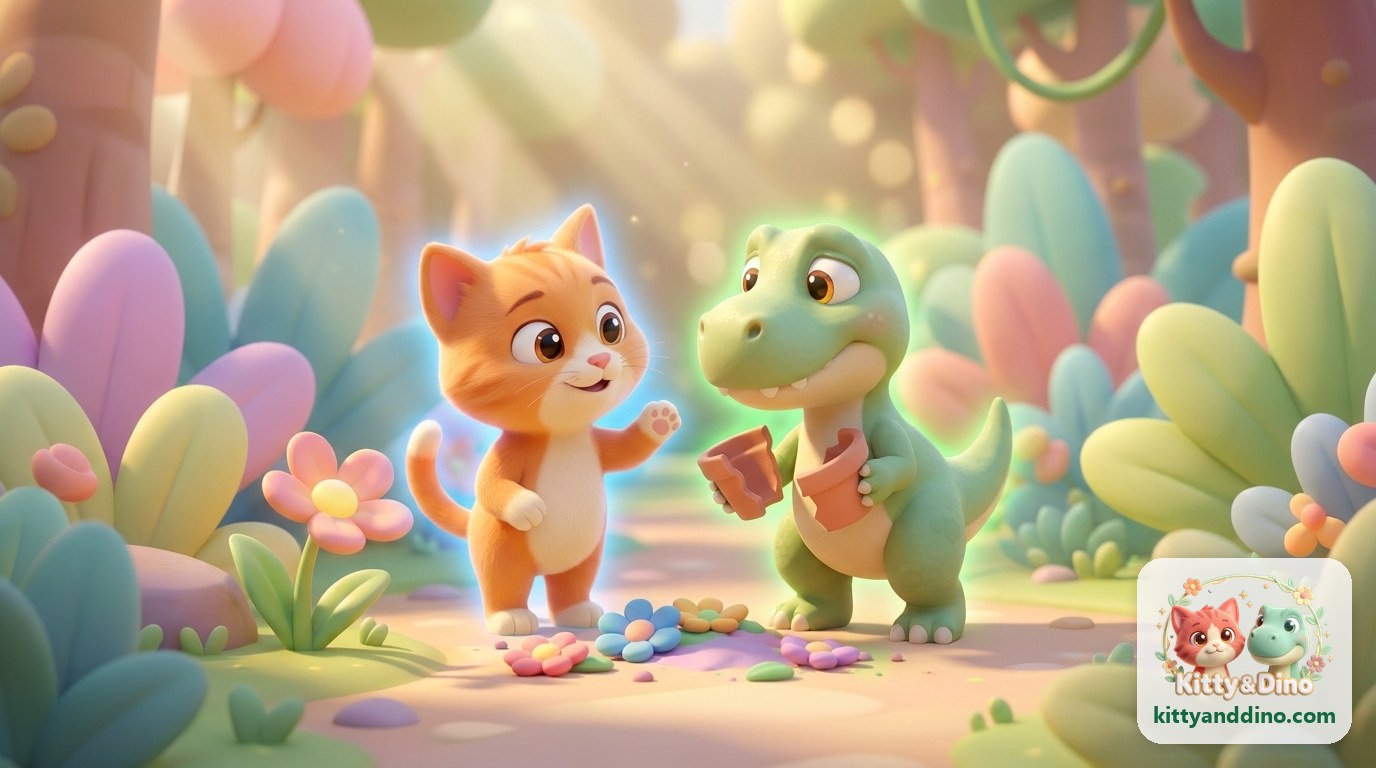
Kitty and Dino Help Milo the Monkey. Milo loves inventing fruit mixes, and his newest juice has magic he didn’t expect: anything it touches floats away. He spills some, and soon half the jungle is drifting into the sky, Mrs. Turtle included. When Kitty and Dino find him, he doesn’t hide it or blame anyone. Almost the first thing he says to them is, “I made a big mistake with my fruit tests!” Nobody scolds him. Dino just asks how the fruit works, and they get to fixing it together, with the first fruit Milo made turning out to be the answer. At the end Milo says that trying new things is good, but he should be more careful. That’s the reason I go back to it for this topic: owning up came first, and it was safe. Free with Kindle Unlimited, or get it on Amazon.
Kitty and Dino Help Milo the Monkey
What to say when your child lies
Don’t ask a question you already know the answer to. “Did you eat the cookies?” with crumbs on their face is an invitation to fib. “I see you ate the cookies. Let’s talk about it” isn’t.
Check whether it’s a story. A parent online suggested asking, “Are you telling a story?” It gives a young child an easy way back, and it keeps the line between pretend and lying clear.
Make owning up worth it. One parent pointed out that punishments can actually lead to kids lying, and it rings true. Thank them for telling you first, then deal with what happened.
Give it a little time. Sometimes they get there on their own, the way my son did with his phone call. If they don’t, a calm talk later works better than a heated one now. And if a mistake is the problem, our list of picture books for a child who gives up easily has a few more stories where getting it wrong is the start, not the end. And if the next step is an apology, our list of picture books about saying sorry and meaning it is the companion to this one.
FAQ: Picture Books About Honesty for Kids
From the Kitty & Dino bookshelf
Gentle picture books about owning up, for ages 3–8:
Read free with Kindle Unlimited → or buy it on Amazon


Pingback: Picture Books for a Child Who Gives Up Easily (Ages 3-8) | Kitty & Dino
Pingback: Picture Books About Saying Sorry and Meaning It | Kitty & Dino