
10 min read
When my son’s first tooth fell out, he put it in a little box and waited for the Tooth Fairy. I’d never told him about her. He’d picked her up from his books, or maybe from his mom or grandmother, and he believed in her completely. So I found a foreign coin and slipped it into the box.
If you’re looking for picture books that encourage imagination, here’s the short answer. Pick the book by the kind of imagining your child does, or doesn’t do yet: turning a box into a rocket, drawing their way into another world, being wild for a while, having a friend nobody else can see, or making something that never quite matches the picture in their head. That’s how this list is sorted, with one question to ask after each book.
Key Takeaways
- Imagination starts with ordinary things: a box, a stick, a toy kitchen, a crayon.
- Pick the book by the kind of imagining your child needs more of, and ask one open question afterward.
- Bored is often where pretend play begins. A book at bedtime can plant the idea for tomorrow.
- Reality matters, but I think there should be room for magic too, as long as it doesn’t harm how a child behaves.
- Our own book about a dream everyone calls impossible is Pippin the Pig, ages 3 to 8, free with Kindle Unlimited.
Why imagination is worth protecting
I grew up on stories. My grandmother’s younger sister told me tales of ancient kings, and an uncle who loved animals made up funny animal fables on the spot. Those stories are what built my imagination. So with my own son, I lean toward leaving room for wonder.
Here’s how I think about it. If we say a tree is a tree, there isn’t much more to it. If we say a fairy lives in that tree, and describe what she does and how she helps people, a child can start to imagine a whole new world. Some parents prefer to give children the plain truth from the start, and I understand why. I agree that reality matters. I just don’t think it should come at the cost of a child’s imagination. He’ll learn the facts at school soon enough.
And when the second tooth came out? I tried telling him the Tooth Fairy only comes for the first one, mostly because I had no idea where I’d find another unusual coin. He didn’t buy it for a second. “No, no, you guys don’t know,” he said. “The Tooth Fairy gives a coin for every single tooth.” He even had my wife check the internet to prove it. She gave in. The tooth went back in the box, and I found another coin. He gets so much joy from it, and I saw no reason to take that away. If a tooth is wobbling in your house right now, our list of picture books about losing a tooth has the rest of our tooth stories.
Picture books that encourage imagination, sorted by the kind of imagining
When a box is never just a box
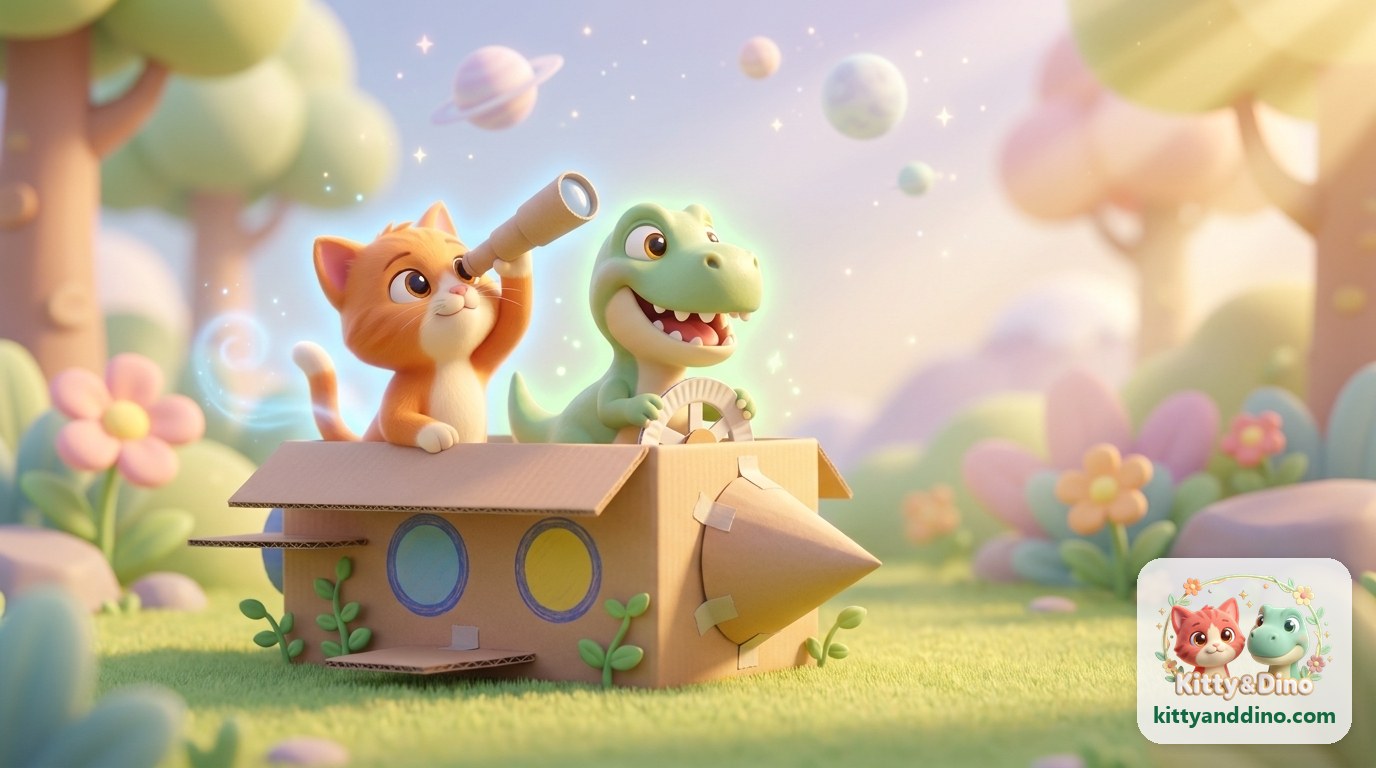
Not a Box by Antoinette Portis. A rabbit keeps telling a grown-up that his cardboard box is not a box. It’s a race car. A mountain. A robot. Tiny and perfect for three and four year olds. Ask afterward: what else could our box be?
Not a Stick by Antoinette Portis. The same idea with a small pig and a stick that becomes a fishing rod, a baton, and much more. Read it before a walk and see what your child picks up.
Roxaboxen by Alice McLerran, illustrated by Barbara Cooney. Children build a whole town out of rocks and old boxes in the desert, and remember it for the rest of their lives. It was one of two books that turned up on most of the imagination lists I read, and it earns that. Best from about four. Ask: if we built a town, what would we call it?

Kitty and Dino Help Pippin the Pig
When they want to draw their way somewhere
Harold and the Purple Crayon by Crockett Johnson. A little boy draws his own moonlit walk with one purple crayon, then draws his way home to bed. Seventy years old and still works, which tells you something.
Journey by Aaron Becker. No words at all. A girl draws a red door on her bedroom wall and walks through it, then draws a boat, a balloon, and a flying carpet to get around. Wordless books are wonderful for this, because your child tells the story.
Imagine! by Raúl Colón. Also wordless. A boy skateboards to an art museum and steps right into the paintings. Better for five and up.
When they need to be wild for a while
Where the Wild Things Are by Maurice Sendak. Max is sent to his room in a wolf suit, sails off to an island of Wild Things, and comes home to find his supper still warm. Every parent knows this one, and there’s a reason it has lasted.
This Is Sadie by Sara O’Leary, illustrated by Julie Morstad. A very inventive girl who has been a mermaid and a boy raised by wolves, all through play. Lovely for the child who already lives half in another world, and for the parent who wonders whether that’s OK. It is.
When the friend is one nobody else can see
The Adventures of Beekle: The Unimaginary Friend by Dan Santat. An imaginary friend gets tired of waiting to be picked, so he sets off to find his real child. Sweet, and a nice way to talk about pretend friends without making them a problem.
When it doesn’t come out the way they pictured
The Most Magnificent Thing by Ashley Spires. A girl sets out to make something magnificent, it keeps going wrong, she gets furious and quits, and a walk helps her see what to fix. Perfect for the child whose imagination is bigger than their hands can manage yet.
Ish by Peter H. Reynolds. Ramon stops drawing after his brother laughs at him, until his little sister shows him that “ish” is good enough. If your child tears up drawings, start here.
When the stories come from family
Ocean Meets Sky by Terry Fan and Eric Fan. Finn builds a boat from scraps to honor his grandfather’s stories, and dreams his way to the place where the ocean meets the sky. This is the one I’d read with a grandparent in the room.
Our book about an impossible dream
This one is ours, so weigh it that way.
Kitty and Dino Help Pippin the Pig. In English people say “when pigs fly” about something impossible. In Sinhala, we say something like “when a tortoise grows feathers.” I wrote Pippin to flip that around for my son, who sometimes decides “I can’t do this” before he’s tried. Pippin tells Kitty and Dino that pigs can’t fly. Nobody tells him he’s wrong to want it. They build a balloon together, the first try won’t float, and after a second go he flies. Imagining it is where it starts, and building it is how it happens. Free with Kindle Unlimited, or get it on Amazon.
A note on another of ours: Walter the Wolf grew out of my son’s toy kitchen. When he was small he used to cook up dishes that didn’t exist and serve them to us, and we’d pretend to eat them. The book itself is about a cooking contest and the friends who help Walter find three rare ingredients, so it isn’t an imagination book as such. But if your child has a play kitchen, they’ll probably like Walter.
Kitty and Dino Help Pippin the Pig

Kitty and Dino Help Walter the Wolf
What to do when your child says “I’m bored”
Let it sit for a minute. Bored is often the step right before pretend play, and the urge to fix it straight away with a screen is strong.
Give them ordinary things. When parents online talk about what got their child playing pretend, a play kitchen comes up again and again, along with boxes, blankets and sticks. My son once took an old remote-control car completely apart with a little screwdriver. I didn’t stop him. If we never let children think and explore, we can’t expect new ideas from them.
Join in with a question instead of a plan. One parent’s advice for a child who never played pretend was to ask something like, “Where is the car going?” Then follow wherever they take it.
Read a story the night before. A book at bedtime can plant an idea for tomorrow’s play. If your child is also scared of what imagination brings out at night, our list of books for kids who are afraid of the dark might help.
FAQ: Picture Books That Encourage Imagination
From the Kitty & Dino bookshelf
Gentle picture books about big dreams and making things, for ages 3–8:
Read free with Kindle Unlimited → or buy it on Amazon


Pingback: The Best Magical Garden Children's Books for Bedtime...
Pingback: Picture Books for a Child Who Gives Up Easily (Ages 3-8) | Kitty & Dino
Pingback: Picture Books About Losing a Tooth | Kitty & Dino