

8 min read
When I was small, I was certain a ghost lived under my bed.
Not a vague worry. A specific ghost, with a specific spot. And I dreamed about him for years.
Here’s the part I still think about. I didn’t hide from him. In the dreams I fought him. I’d haul him out from under the bed and tell him he couldn’t stay in there, and I’d chase him off. And when it got to be too much, when the fear got bigger than the fight, I had an escape route worked out. I’d run to our front door, jump, and float toward the neighbor’s flower bed. The moment I reached the flowers, I’d wake up.
I was maybe six. Nobody taught me that. I built it myself because I needed it.
Years later I wrote a book about a forest where the lights went out, and only afterward did I notice where it came from.
Key Takeaways
- “There’s nothing there” almost never works. The fear is real to them even when the ghost isn’t.
- Name the feeling first, then move. Skipping to reassurance tends to shut the conversation down.
- The books that help most give the dark a shape, so the child has something to face instead of a formless nothing.
- Small controllables matter: a lamp they switch, a door left at their chosen gap, a soft light that’s theirs.
- Our Sunny the Parrot came from the ghost under my own bed, and the neighbor’s flower bed I escaped to.
Why “there’s nothing to be scared of” doesn’t land
It’s the first thing most of us say, and it’s true, and it does almost nothing. I’ve said it plenty of times myself.
The trouble is it argues with the feeling instead of meeting it. A four-year-old lying in the dark isn’t making a factual claim you can correct. He’s having an experience. Telling him the experience is wrong just teaches him not to mention it next time.
What works better, in my house at least, is naming it before doing anything about it. “The dark feels different, doesn’t it. Everything looks bigger.” That’s it. You’re not agreeing there’s a monster. You’re agreeing he’s scared, which he definitely is. Once a kid feels understood he’ll usually let you help. Push before that and he digs in.
It’s the same move I’d use for any big feeling, the one I lean on when he doesn’t want to go back to school after a break. Name it, then point at the small next step. We do the same thing with a child who’s scared to try again, and honestly it’s most of what stories about facing fear are quietly doing too.
Books for kids who are afraid of the dark
1. The Dark by Lemony Snicket, illustrated by Jon Klassen
Laszlo is afraid of the dark, and the dark lives in his house, down in the basement. Then one night the dark comes up to visit him.
The move here is turning the dark into a character. It talks. It has a house of its own. That sounds like it would be scarier and it’s the opposite, because now the thing has edges. A child can look at a character. A formless dark is much harder to look at.
Klassen’s illustrations do a lot of the work, big black spaces that never feel threatening. Good for about four and up.
2. Can’t You Sleep, Little Bear? by Martin Waddell, illustrated by Barbara Firth
Little Bear can’t sleep. Big Bear brings him a lantern. Still dark. A bigger lantern. Still dark. Bigger one again. Nothing works, until Big Bear carries him outside and shows him the moon and the stars.
This is the gentlest one on the list and the best for a three-year-old. It also quietly models the right parental posture. Big Bear never once tells Little Bear he’s being silly. He just keeps trying things, and stays.
3. Orion and the Dark by Emma Yarlett
Orion is scared of plenty of things, and the dark tops the list. So the Dark turns up and takes him out for the night. Along the way it turns out the Dark has its own fear, of odd night noises, and Orion ends up being the one helping.
Handing the scared child the helping role is a clever flip, and kids feel the switch. Best for four and up, since there’s more text than the other two.
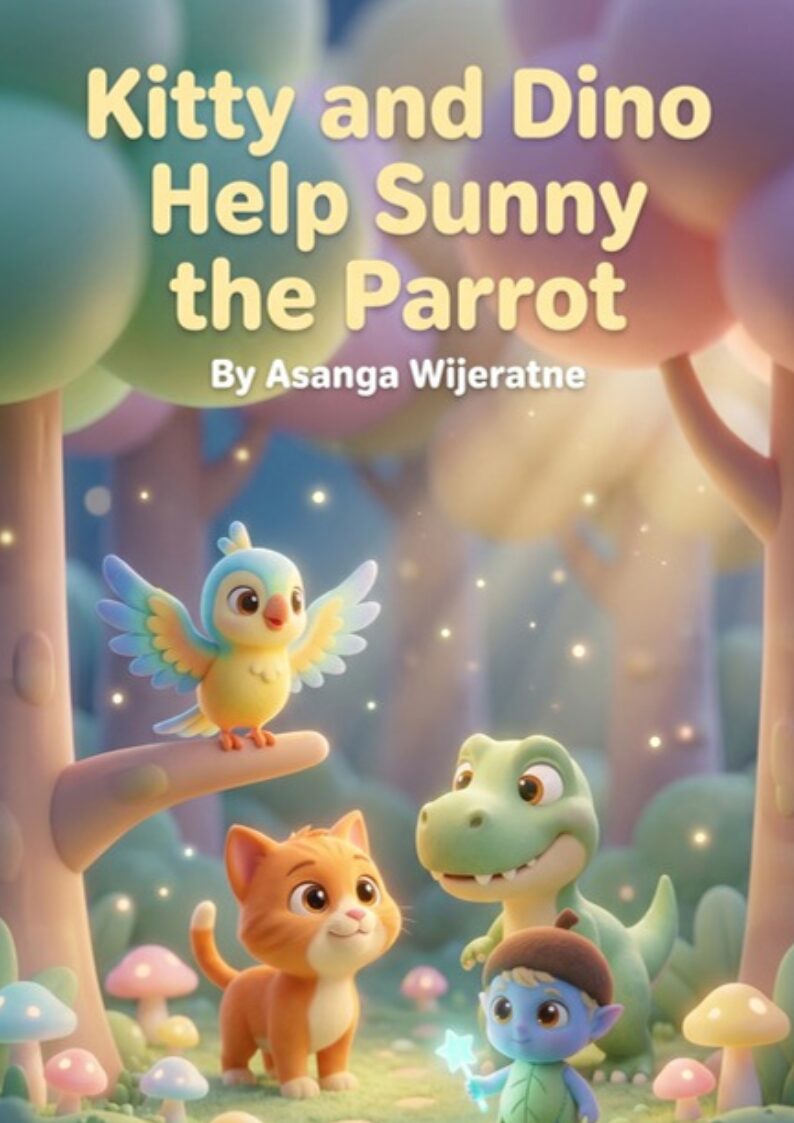
4. Kitty and Dino Help Sunny the Parrot
This one’s mine, and it’s the ghost story from the top of this post wearing a costume.
Sunny is a parrot who notices the small animals in the forest aren’t sleeping. The reason is that the elf who used to light up the nights with sparkling lights has stopped doing it. So Sunny asks Kitty and Dino for help, and the three of them go find the elf and get the lights going again.
My son only gave me the animal. He wanted a parrot story, that was the whole brief. Everything else came out of my own childhood without me really planning it. The dark forest was the space under my bed. The elf’s lights were that flower bed I’d float to when I needed out.
I didn’t set out to write about being scared of the dark. I set out to write a parrot story and my six-year-old self showed up anyway.
What actually helps at bedtime
The book is one piece. A few other things have earned their place in our house.
Give them a switch. Fear of the dark is mostly a control problem. A small lamp your child turns on and off himself is worth more than a brighter one you control. Same with the door. Ask what gap he wants it open to, then leave it exactly there.
Do the same things in the same order. Predictability does a lot of the calming on its own. If bedtime is a different shape every night, the dark at the end of it is a different dark every night too. We wrote out the seven-step routine we actually use if you want a starting shape.
Keep the last story calm. This matters more than people expect. A story that ends on excitement leaves a wound-up kid in a dark room. Short stories that wind down instead of up are the ones to reach for here.
Let the fear be a normal thing to mention. If he can say “I’m scared” without getting corrected, you’ll keep hearing about it, and you can keep helping. That’s worth more than getting him to stop saying it.
And remember it is partly a waiting problem. Lying in the dark waiting for sleep is its own small endurance test. It gets harder when one parent is travelling, which is its own particular kind of night. If your child finds any kind of waiting hard, these patience books are worth a look alongside the ones above.
And if what’s keeping your child awake is a doctor or hospital visit coming up, books for kids going to the doctor might help.
One more thing
My ghost went away eventually. I don’t remember the night it stopped, which probably tells you something. There was no big moment where somebody convinced me.
What I remember is the flower bed. The escape hatch I invented, that I could use whenever I needed it. I think that’s the actual thing a scared kid needs, not proof the dark is empty. Just something of their own to hold onto in it.
A lamp with their own switch will do. So will a story where the lights come back on.
FAQ: Kids Afraid of the Dark
From the Kitty & Dino bookshelf
Gentle picture books that bring this to life for ages 3–8:


Pingback: Picture Books That Encourage Imagination | Kitty & Dino
Pingback: When Your Child Is Scared to Try Again (A Story That Helps)
Pingback: Why Kids Take Things Apart | Kitty & Dino