

11 min read
My son has two sets of grandparents, and he remembers them in completely different ways.
My wife’s parents live close by. Her aunt too. While we’re at work he’s with them most of the day, so he knows them the way he knows our own kitchen. He talks their ears off. He throws tantrums at them. There’s no single memory there, because it never stops long enough to become one.
My parents live about three hours away. We make the drive maybe once every two or three months.
Same boy. Same love, as far as I can tell. But what he keeps from the far house is small, specific, and a little strange.
Key Takeaways
- A child who sees a grandparent a few times a year keeps fragments rather than a full picture. That’s normal.
- The fragments are usually sensory. A smell in a kitchen, one particular dish, a toy that was waiting.
- Objects and rituals hold a connection better than explanations do.
- Books where the grandparent never appears often land harder than books about a visit.
- Our own book on this is Bramble the Bear, ages 3 to 8, free with Kindle Unlimited.
A week and a half of cooking, for two days of visit
Here’s the part I didn’t understand until I’d watched it happen a few times.
Whenever we told my mother we were coming, she’d start about a week and a half ahead. Cooking his favorites, one at a time, working down the list like a ritual. My aunts live right next door in the old family house, and they’d start too. By the time we pulled in, that house was full of food he loved and toys somebody had gone out and bought for him.
And then we’d stay two days.
Two days, against ten days of getting ready. You’d think a child would come away carrying some grand impression of all that love pointed at him. He didn’t. What he came away with was the smell of that kitchen and one particular dish.
That used to bother me a little. It doesn’t now. He isn’t being ungrateful, he’s being small. There isn’t enough time in two days to build the kind of picture he’s built of the grandparents he sees every week. So he keeps whatever fits.
What he actually kept
When he was three, my mother got ill, and she was ill for a long time.
The visits changed after that. We’d arrive and spend them focused on her, on medicine, on trying to get her comfortable. Not much of it was about him anymore, and he was too small for anyone to explain it properly.
He worked out his own version. He’d walk up to the bedroom door and stand there and look at his grandmother. Sometimes he’d go in, sit by the bed, and stroke her head for five or ten minutes. Then he’d come back out and get on with whatever he’d been doing.
That’s what he kept from that whole stretch. Not the worry in the house. Not any of the conversations. Five minutes at a bedside, over and over.
So when a parent tells me she’s worried her child is forgetting a grandparent he hardly sees, I don’t think he is. He’s keeping less than she’d keep, and keeping different things. A kite somebody made him. A cake. The sound of one particular voice saying his name wrong on purpose.
Books for a child missing a far-away grandparent
The ones that work best share a trick. The grandparent isn’t there, and the whole book is about them anyway. That’s much closer to what your child is actually living than a story about a lovely visit.
Tomatoes for Neela by Padma Lakshmi, illustrated by Juana Martinez-Neal
Neela cooks with her mother and writes the recipes down in a notebook, and it’s how she stays close to her paati, her grandmother, far away in India. They go to the market for tomatoes to make Paati’s sauce, and Neela learns where the tomatoes came from on the way.
This is the strongest one on the list for this particular feeling. Paati never walks into the story and the story is entirely hers. If your family has a recipe, read this and then go cook it. That’s the whole activity, and it works.
When I See Grandma Again by Jennifer Greenwell
Written specifically for long-distance grandparents and the grandchildren who miss them. It sits with the small moments that outlast a visit, and it’s honest that missing someone is part of loving them rather than a problem to be solved.
Less known than the others here. Worth hunting down if the distance in your family is the permanent kind rather than one bad year.
Llama Llama Gram and Grandpa by Anna Dewdney
Llama Llama stays overnight at Gram and Grandpa’s for the first time, and at bedtime realizes Fuzzy Llama got left at home. Grandpa turns up with a toy from his own childhood, and Llama works out that he’s in a home away from home.
Why it belongs here: the comfort doesn’t come from a parent showing up. It comes from the grandparent having been a small child once too. Three-year-olds find that idea genuinely startling. Mine did.
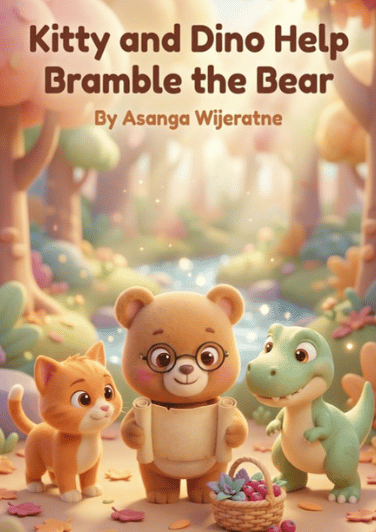
Kitty and Dino Help Bramble the Bear
Bramble is the forest’s healer, and half the animals have coughs. He’s got his grandfather’s old recipe, but it asks for things that are hard to get: purple-tipped mint by a cold stream, red berries at the top of the tallest tree, white clay buried deep underground. Kitty chills the water and opens the earth, Dino grows the climbing vines, and the three of them gather every piece and brew the cure together.
The grandfather never appears. His recipe does, and it still works, and that’s the entire reason he’s in the book.
It came out of my own family. My great-aunt, the one we called Punchi Achchi, kept a handwritten book of traditional remedies. My father’s side has a line of village healers in it, including a grand-uncle who wrote out cures in Sinhala verse that nobody ever recovered. I grew up knowing those books existed and mostly knowing they were gone.
Ages 3 to 8. See the paperback on Amazon, or read it free with Kindle Unlimited.
Something I only noticed afterward
Two other books in our series are built around a grandparent, and I wrote both of them during the years my mother was ill.
In Slither the Snake, Slither’s grandfather is very old, and the only thing that can help him is the family’s healing diamond, hidden in the caves past the Misty Rocks. Kitty and Dino go with him. They clear the fog, solve an old riddle of water and earth and fire, and make a run for it as the cave starts coming down. In Bobo the Baboon, Bobo’s grandma is sick, and he’s sitting on a rock crying over a worn stone tablet that nobody can read, which is meant to hold the way to a healing waterfall.
Honestly, I wasn’t thinking about my mother when I wrote either one. I only saw it later. A small character going to ridiculous lengths for a grandparent, taking risks well past his size, refusing to accept that nothing more can be done. That was our house at the time, and I put it on the page without noticing.
If that’s nearer to where your family is right now, I wrote about books for a child whose grandparent is ill separately. It’s a different conversation than this one.
What helped in our house
Give him something physical. A photograph he’s allowed to carry around and bend. A jumper that still smells faintly of the wrong house. Objects outlast explanations, and a three-year-old can’t argue with a jumper.
Keep one ritual that belongs only to that grandparent. Ours is a particular way of saying goodnight. Takes four seconds, survives months of not seeing anybody.
On video calls, do something instead of talking. Reading the same book at both ends beats “say hello to Achchi,” which reliably produces a child hiding behind a knee. Cooking together over a screen works too, badly and messily and well enough.
And I’d be careful about naming the next visit. If the date might move, don’t say it out loud. A child who was told December and gets February has learned something you didn’t mean to teach him.
Afterward
The missing isn’t the problem to fix. It’s what it feels like when a small person loves somebody he can’t get to. The same shape turns up when it is a parent who is away rather than a grandparent, and a child handles that one much the same way.
You’re only trying to keep it warm instead of letting it go blank. A book, a recipe, a bent photograph, five minutes at a bedside. Low bar. Holds surprisingly well.
Books about grandparents, more generally
Not every child is missing a grandparent because of distance. If you came here looking for books about grandparents in the broader sense, it is worth knowing that the shelf splits into three fairly different things, and they are not interchangeable.
There are books about a grandparent who lives far away, which is what this page is about. There are books about a grandparent who is ill, which is a heavier conversation and has its own page. And there are books about a grandparent who has died, which we have deliberately not written about, because handling that badly does real damage and I have not found the right way in yet.
If you are not sure which one you need, the honest test is what your child has actually asked you. A child who asks when they are next seeing Grandma needs the first kind. A child who has gone quiet needs a different conversation altogether.
FAQ: Books About Long-Distance Grandparents
From the Kitty & Dino bookshelf
Gentle picture books about grandparents, for ages 3–8:


Pingback: Children's Books About a Sick Grandparent | Kitty & Dino
Pingback: How to Choose Picture Books for Your Child's Age (Ages 3-8)