

8 min read
In 2021 my wife and I both tested positive for COVID. Our son was six or seven months old. He went to his grandparents for about a week, and we stayed home and waited. Years later I ended up writing about the other side of that house too, when it was a grandparent who was ill rather than us who were away.
He couldn’t talk yet. That was the part I kept turning over. There was no way to explain it to him, no way to say we’re coming back in a form he could hold onto. We just disappeared for a week.
When we finally came to get him, he clapped. Then he kept clapping, and smiling, and clapping again, and he would not stop.
Key Takeaways
- A child too young to talk about it still feels it. So does an older one who refuses to.
- Don’t promise a return date you can’t control. Give them something to count instead.
- The anger usually lands on the parent who stayed, not the one who left. That’s normal.
- Books where somebody is trying to get home work better than books that explain absence.
- Our own book on this is Stripes the Tiger, ages 3 to 8, free with Kindle Unlimited.
What a child actually does when a parent is away
Not much, usually. That’s the confusing part.
You brace for crying at the door and instead you get a kid who seems fine, plays normally, eats dinner, goes to bed. Then three days in, they wet the bed. Or they start needing you in the room to fall asleep again, after two years of not needing that. Or they get furious about a sock.
It comes out sideways. Almost always.
The other thing nobody warns you about: they’re often angrier at you than at the parent who left. You’re the one who’s there. You’re safe to be angry at. It stings, and it means the attachment is working exactly as it should, which is cold comfort at 6pm on day four.
Young kids also don’t have a working sense of a week. “Daddy comes back Sunday” means nothing to a four-year-old. Sunday is a word. What they understand is five more sleeps, or a paper chain with five loops to tear off, or a jar with five stones to move across.
Books for a child missing a parent who’s away
I’d skip anything that sets out to explain absence. Kids don’t need the concept, they’ve already got the feeling. What helps is a story where somebody is separated and then gets back, so the child gets to watch the ending land.
1. Owl Babies by Martin Waddell, illustrated by Patrick Benson
Three baby owls wake up and their mother isn’t there. They sit on a branch and work themselves up about it. Sarah is reasonable, Percy is nervous, and Bill just says “I want my mommy” over and over, which is the truest line in any picture book about this.
Then she comes back. That’s the whole thing. For under-fives it’s close to perfect, because the worry is taken completely seriously and then resolved without a lesson attached.
2. The Kissing Hand by Audrey Penn
Chester Raccoon doesn’t want to go to school, so his mother kisses his palm and tells him the kiss stays there. He presses his hand to his cheek when he needs it.
It’s written for the first day of school, but the mechanic transfers. We used a version of it. It gives the child something physical to do when the feeling shows up, which beats being told the feeling will pass.
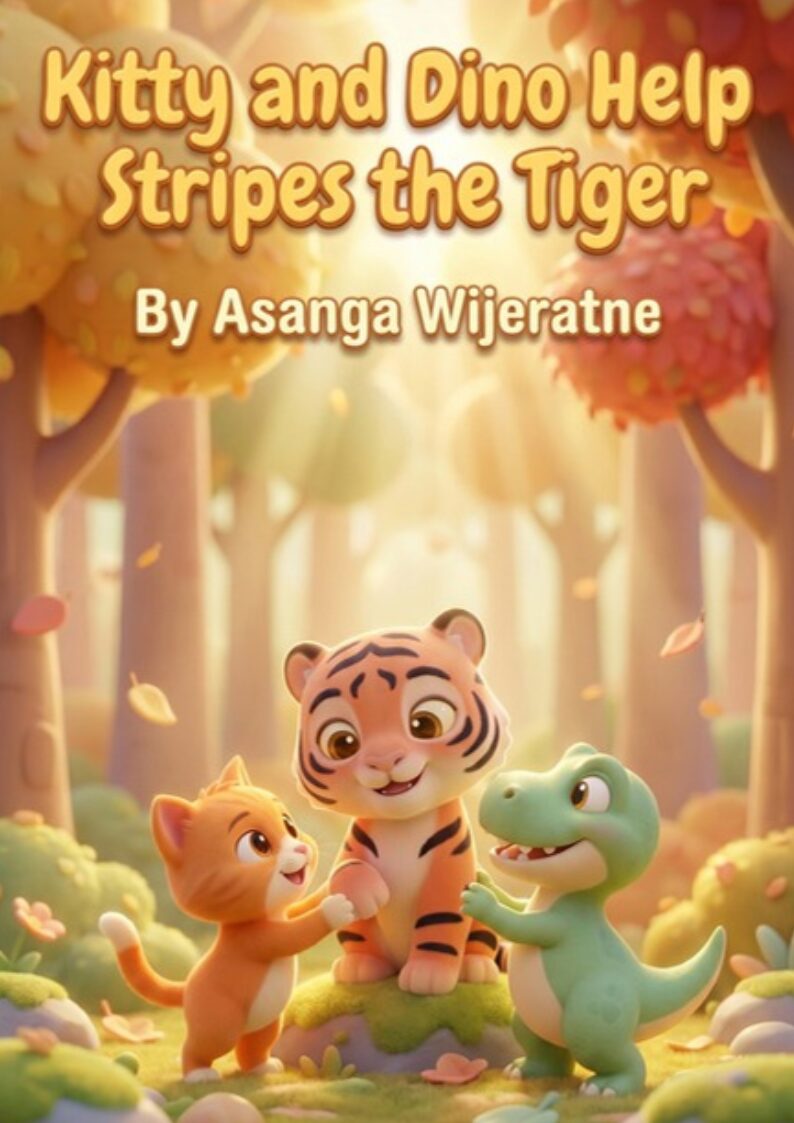
3. Kitty and Dino Help Stripes the Tiger
This is the one I wrote from that week in 2021.
Stripes is a tiger who’s hurt and can’t make it home. What weighs on him isn’t the injury. It’s knowing his family is waiting, and afraid. Kitty and Dino find him, heal his wound, and walk him back.
I flipped the point of view on purpose. Most books on this sit with the child who’s left behind, and my son was the one left behind, but the story I needed to tell was the other side of it: the one who’s away is trying to get to you the whole time. That’s what I couldn’t say to a seven-month-old. So I said it later, in a book, when he was old enough to hear it.
Ages 3 to 8. See the paperback on Amazon, or read it free with Kindle Unlimited.
4. I Miss You, Stinky Face by Lisa McCourt
A boy asks his mother every increasingly ridiculous question about what could go wrong while she’s away, and she answers all of them seriously. Comic on the surface, and underneath it’s a kid checking whether the connection holds under pressure.
Good for the child who won’t say “I miss you” but will happily interrogate you for twenty minutes about hypothetical dragons.
5. Mama and Mommy and Me in the Middle by Nina LaCour
One mother goes away for a work trip and the book stays with the days in between. It’s quiet and it doesn’t rush to the reunion, which makes it the more honest one on this list, though I’d read it with a child who’s already settled rather than on night one.
What helped in our house, and what didn’t
Something to count worked. We didn’t have that in 2021 because he was a baby, but we’ve used it since for work trips. Five stones, a jar, move one every morning. The child gets to see it shrinking.
Video calls were a mixed bag, honestly. Sometimes they helped. Sometimes they reset the whole thing and we’d lose the evening. I stopped treating them as automatically good.
What didn’t work: “don’t be sad.” It never works. Nobody has ever stopped being sad on instruction. Naming it does more, and it doesn’t have to be a whole conversation. “You miss her. Yeah. Me too.” Then carry on making dinner.
And I’d be careful with promises. If the trip might slip by a day, don’t name the day. A child who’s been told Sunday and gets Monday learns something you didn’t mean to teach.
If the hard goodbye is at the school gate rather than the front door, our list of picture books for a child who doesn’t want to go to school starts with books for exactly that.
Afterward
He’s older now and he doesn’t remember that week at all. I do. I remember the clapping most, because it went on far longer than made sense, and because it was the only vocabulary he had.
Whatever’s keeping you apart right now — a hospital, a job, a plane, a visa — the ending is the part they need. Not the explanation. Just the coming home, told enough times that they start to believe it’s how these stories go.
FAQ: Children’s Books for When a Parent Is Away
From the Kitty & Dino bookshelf
Gentle picture books that bring this to life for ages 3–8:


Pingback: Books for a Child Who Doesn’t Want to Go to School | Kitty & Dino
Pingback: Books About Going to the Doctor for Kids | Kitty & Dino
Pingback: Children's Books About a Sick Grandparent | Kitty & Dino
Pingback: Books for Kids Afraid of the Dark | Kitty & Dino