7 min read
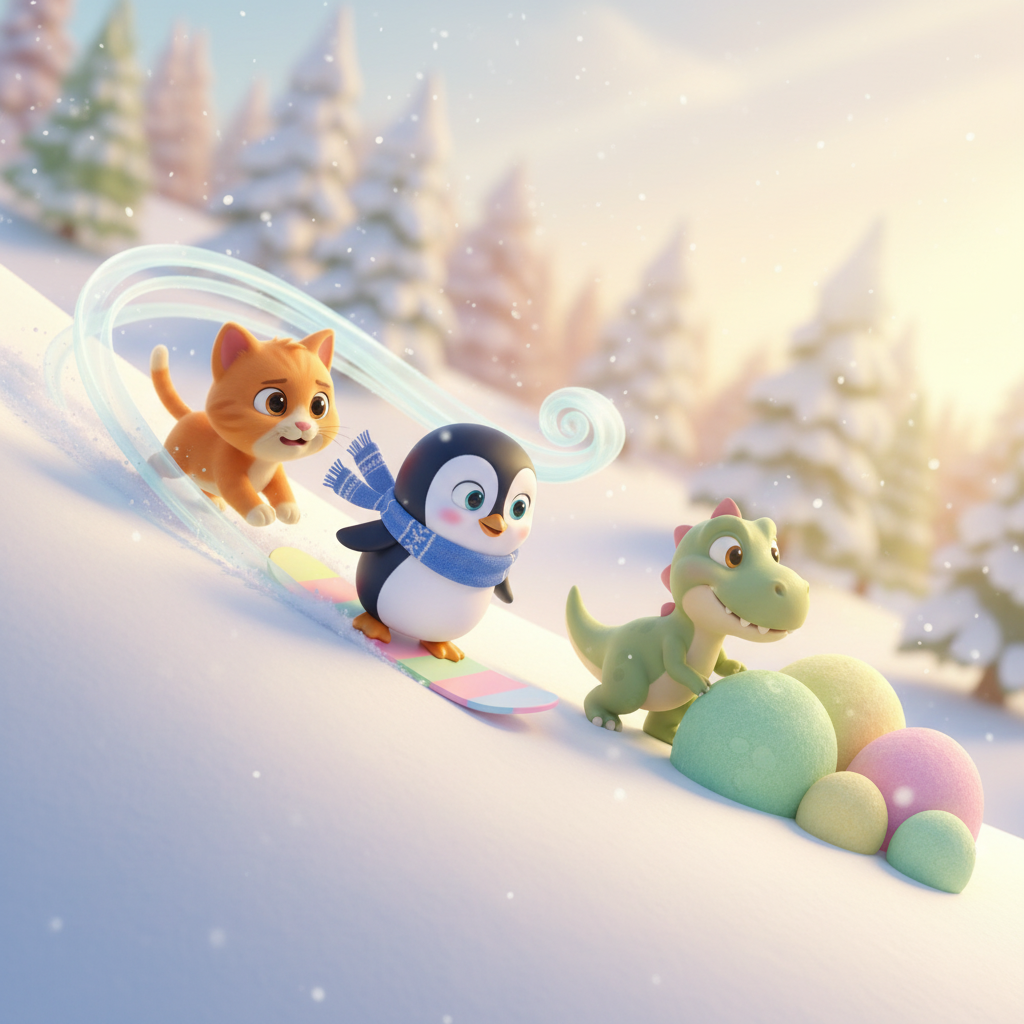
Penny stood at the top of the highest peak, snowboard trembling beneath her flippers. The Triple Loop—the legendary trick that separates champions from beginners—loomed before her. She’d watched the older penguins do it. She’d dreamed about it. She was ready.
She wasn’t ready.
The crash was spectacular. Ice everywhere. Ego bruised. And worst of all, Penny’s magic spiraled into that chaotic snowstorm—flurries of emotion she couldn’t control, couldn’t stop, couldn’t even understand.
As parents, we see this all the time. The first day of school. The big recital. The “I can do it myself” independence grab that ends in tears. Our kids see the Triple Loop—whatever that represents for them—and they want it. They demand it. They insist they’re ready.
And sometimes, like Penny, they crash.
The Strategy: Bunny Hills Before Black Diamonds
Enter Kitty and Dino with their revolutionary idea: what if Penny didn’t need to conquer the Triple Loop today?
Instead of rebuilding the massive jump, they took her to the bunny hill. A six-inch mound of snow. “Just clear this,” Kitty said. “That’s all.”
Penny landed it perfectly. Then came the twelve-inch drift. Then the small kicker. Then the medium hill with a gentle slope.
Each landing rebuilt Penny’s relationship with gravity. Each small jump reminded her muscles what confidence felt like before her brain had to panic about the spinning. By the time she approached the Triple Loop again, she wasn’t hoping she could do it—she knew she could, because she’d done seventy-five smaller versions already.
This approach—breaking big challenges into manageable micro-wins—is what we call the Triple Loop Method. It’s a framework for helping children (ages 3–8 and beyond) build genuine confidence by never letting a challenge exceed what their current abilities can handle.
The Psychology Behind Small Wins
This isn’t just a cute penguin story. This is Gradual Exposure 101, backed by developmental psychology.
When children (and penguins) face a challenge that triggers their threat response, their prefrontal cortex—the part that handles rational thinking and skill execution—goes offline. The amygdala, their internal alarm system, takes over. That’s when we get the snowstorms, the tantrums, the shutdowns.
Neuroscience research confirms this pattern. According to Dr. Daniel Siegel’s hand model of the brain, when a child becomes emotionally overwhelmed, the ” upstairs brain” (prefrontal cortex—decision-making, emotional regulation) goes offline, and the “downstairs brain” (limbic system—fight/flight/freeze responses) takes over. This isn’t defiance; it’s neurological. [Source: Siegel, D. & Bryson, T. (2012). The Whole-Brain Child. Delacorte Press.]
The Triple Loop Method works because it keeps the upstairs brain online. By breaking the big trick into micro-wins, we keep the child in what psychologist Lev Vygotsky called the “Zone of Proximal Development”—the sweet spot where something is challenging enough to be exciting, but not so hard that it triggers panic. [Source: Vygotsky, L. (1978). Mind in Society. Harvard University Press.]
Every small jump releases dopamine—the brain’s reward chemical. Every safe landing builds procedural memory. The brain starts associating the sensation of trying (reading, socializing, learning new skills) with success rather than threat. This is the neuroscience of confidence: your body learns to feel safe while doing hard things.
By the time Penny attempted the Triple Loop for real, her body remembered safety even when her mind felt nervous.
Real-World Application: Building Your Child’s Staircase to Bravery
So how do we apply the Triple Loop Method without actually building snow ramps in the backyard?
The Reading Triple Loop
Your child wants to read chapter books like their big sister, but they’re still sounding out CVC words. Don’t ban the chapter books (that creates shame), but don’t let them struggle through alone (that creates failure). Instead: read the chapter book together, alternating pages. Then try the graphic novel version. Then the early reader adaptation. Then the solo attempt. Each step feels like progress, and the final challenge is just one more bunny hill on a mountain they’ve already climbed.
The Social Triple Loop
Birthday parties terrify your little one, but they want to go because their friends are there. Don’t throw them into the three-hour bash (Triple Loop). Start with a 30-minute playdate with one child. Then an hour with two. Then the party, but you’ll stay in the hallway. Then the drop-off party. The social challenge stays within their Zone of Proximal Development at every step.
The Independence Triple Loop
They want to pour their own milk but flood the kitchen every time. Start with pouring water outside. Then pouring from a small pitcher at the table. Then the milk carton with supervision. Then solo pouring. Each version is slightly harder, but never overwhelming.
The key is sequencing. Each version must be slightly harder than the last, but not so hard that “magic turns to snow.” As Kitty and Dino discovered with Penny, the secret to helping a child through their Triple Loop isn’t raw willpower—it’s engineering the approach so the challenge always feels survivable.
When a child is mid-crash—whether from a tantrum, withdrawal, or emotional flooding—the first step isn’t to solve the behavior. The first step is to recognize that behavior is communication, and that what looks like “bad behavior” is often just scared magic.
The Landing: When Small Wins Become Big Tricks
Penny didn’t need to be braver. She needed a better staircase to bravery.
When she finally landed the Triple Loop—when she stuck that landing and felt her magic settle back into its proper, sparkling place—it wasn’t because she gritted her teeth and tried harder. It was because she had proof. Seventy-five pieces of proof that she could land, that she was safe, that her magic worked when she wasn’t terrified.
If your child is crashing on their Triple Loop—whether that’s math, friendship, or learning to ride a bike—remember that small jumps aren’t “baby steps.” They’re engineering. They’re neuroscience. They’re love.
Frequently Asked Questions
What is the Triple Loop Method for children?
The Triple Loop Method is a confidence-building approach inspired by a story about Penny the Snowboarding Penguin. When children face a challenge that’s too big too soon, they crash emotionally. The method teaches parents to break big challenges into small, achievable “bunny hills”—micro-wins that rebuild confidence before attempting the big goal.
How do small wins build child confidence?
Every small jump releases dopamine, and every safe landing builds procedural memory. By breaking a big challenge into micro-wins, the brain starts associating trying with success rather than threat. By the time a child approaches the big challenge, their body remembers safety even when their mind feels nervous.
What is the Zone of Proximal Development?
The Zone of Proximal Development (ZPD), introduced by psychologist Lev Vygotsky, is the sweet spot where a challenge is exciting enough to be engaging but not so hard that it triggers panic. The Triple Loop Method keeps children in their ZPD by never letting the challenge exceed what their current abilities can handle.
What are examples of the Triple Loop Method in real life?
The Triple Loop Method applies to reading (start with picture books, progress to graphic novels, then early readers, then chapter books), social situations (attend a 30-minute playdate before a 3-hour party), and independence skills (pour water outside, then from a small pitcher, then supervised milk pouring, then solo).
Get the Full Story (Amazon)
Ready to teach your child the Triple Loop Method? Read the full story of how Kitty and Dino helped Penny find her confidence again in Kitty and Dino: The Snowboarding Penguin.
From the Kitty & Dino bookshelf
Gentle picture books that bring this to life for ages 3–8: