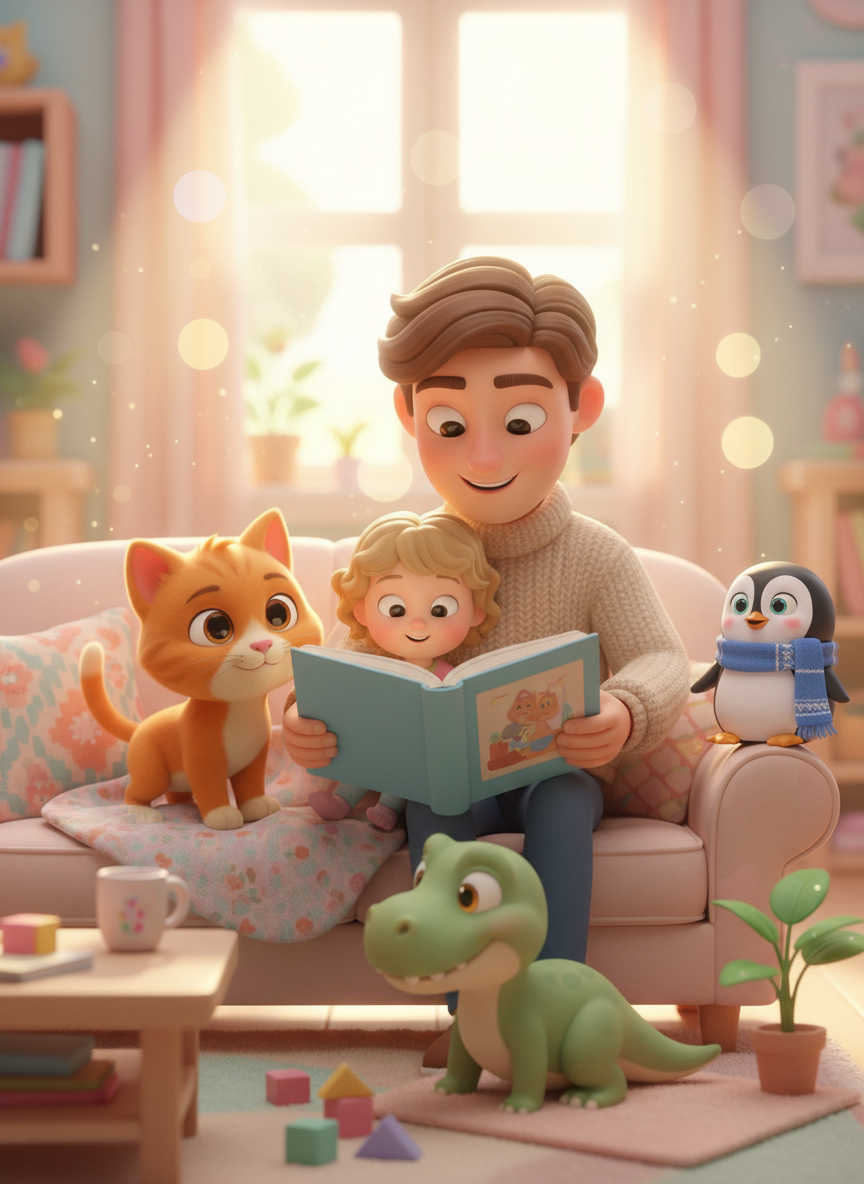
If you only had one 20-minute window to connect with your child each day, how would you spend it? For many families, that window is bedtime — and there’s a reason reading together has been the go-to ritual for generations. Science now confirms what parents have always known: reading to your child isn’t just about teaching words. It’s about building something deeper.
📝 Key Takeaways
- What’s the main lesson? — Every life matters, no matter how small or different.
- How does this book teach compassion? — Through a story where characters help without asking if it’s deserved.
- Best for ages: — 3-8 years, during the crucial empathy development window.
The Bond That Forms When You Read Together
When a parent reads to a child, something remarkable happens. The physical closeness — sitting on a lap, leaning against a shoulder, snuggling under blankets — releases oxytocin in both parent and child. This hormone, often called the “bonding hormone,” creates feelings of safety, trust, and emotional connection. Research from the University of Cambridge found that children who are read to regularly show stronger parent-child attachment scores than those who aren’t.
But the bonding goes beyond just feeling close. During storytime, your child hears your voice modulated with emotion — rising with excitement, softening with tenderness, pausing for suspense. They learn to read your emotional cues through tone, building the foundation for empathy and emotional intelligence that will serve them throughout life.
Why Shared Stories Create Shared Language
Families who read together develop something psychologists call “shared reference points” — the inside jokes, the favorite characters, the phrases that become part of family culture. When your child says “Remember when Penny tried the triple jump?” and you both smile, you’re not just recalling a story. You’re signaling belonging. You’re saying: This memory is ours.
In Penny the Penguin, Kitty and Dino become these reference points. When your child faces a challenge, you might say “What would Kitty do?” or “Remember how Dino helped Penny try again?” These characters become part of your family’s emotional vocabulary, giving you tools to communicate about courage, friendship, and persistence in ways your child understands.
The Brain Science of Connection
Neuroimaging studies show that when parents and children read together, their brain waves actually synchronize. Researchers at Princeton University found that this “brain coupling” creates a shared mental state that enhances learning, emotional regulation, and relationship building. Simply put: your brains are literally on the same wavelength during storytime.
This synchronization is especially valuable during the 3-8 age range, when children are developing their sense of self and their understanding of relationships. The secure base you create during bedtime reading becomes the foundation from which they explore the world — knowing they can always return to the safety of your lap and a good story.
Beyond the Words: What Your Child Really Gets
When you read Penny the Penguin to your child, you’re giving them far more than a story about a penguin who learns to snowboard. You’re showing them:
- That you’re available: In a world of constant distractions, 20 minutes of focused attention says “You matter to me.”
- That it’s safe to struggle: Watching Penny face her fear with support teaches your child that challenges are normal and help is available.
- That trying again is valuable: The triple loop method becomes a family mantra for resilience.
- That stories have power: They learn that narratives help us process experiences and emotions.
These lessons stay with children long after they’ve outgrown picture books. Research from the University of Melbourne tracked children who were read to regularly and found they maintained stronger emotional bonds with their parents into adolescence.
The Long-Term Gift
Here’s something beautiful about the reading ritual: it doesn’t end when your child learns to read. Many families continue reading together well into the elementary years, transitioning to chapter books and taking turns reading pages. The ritual evolves, but the bond remains.
Even when your child eventually reads independently, the foundation you’ve built remains. They’ll remember those quiet evenings, the sound of your voice, the characters you loved together. And when they have children of their own, many will instinctively reach for a book at bedtime, continuing the chain of connection that started with you.
FAQ: Parent-Child Bonding Through Reading
I’m not a “good” reader. Will my child still benefit? Absolutely. What matters is the connection, not your performance. Your child loves your voice. They want your time. Picture books like Penny the Penguin are designed to be read together, with illustrations that carry part of the storytelling load.
What if I don’t have 20 minutes? Quality matters more than quantity. Even 10 minutes of focused, present reading builds connection. And remember: the routine matters. A short daily ritual beats occasional long sessions.
Can dads do bedtime reading too? Research shows that reading with dads has unique benefits. Fathers often bring different energy to storytime — more physical play, different voices, different emotional framing. Children benefit from both styles.
What age should I start? It’s never too early. Newborns benefit from hearing your voice and feeling your closeness. By age 3-4, they can engage with simple narratives like Penny the Penguin. By 5-8, they’re following more complex plots and starting to “read” the pictures themselves.
Start Building Tonight
If you’re looking for a story that helps build both connection and resilience, Penny the Penguin is designed for this exact purpose. The story of a penguin who faces her fears with the help of true friends gives you natural conversation starters about courage, friendship, and trying again.
Tonight, when you open the book, know that you’re doing more than entertaining your child. You’re building a bond that will last for years. You’re creating memories. You’re showing them that they matter. And you’re giving them the gift of knowing that whatever challenges they face, they have someone who will sit beside them and say, “Let’s try again together.”
Get your copy of Penny the Penguin on Amazon and start building your family’s storytime tradition.
Buy Penny the Penguin on Amazon →
Visit kittyanddino.com to browse all our children’s books.
TL;DR Summary
Quick Takeaways:
- Children learn compassion through stories, not lectures
- This book shows kindness in action — characters help without asking why
- Perfect for ages 3-8 during the empathy development years
- Based on a real story that makes it emotionally authentic