—
title: Calming Bedtime Activities for Kids: A Screen-Free Wind-Down Guide
meta_title: Calming Bedtime Activities for Kids: A Screen-Free Wind-Down Guide | Kitty & Dino
meta_description: Discover 5 calming, screen-free bedtime activities for kids ages 3-8. Create a peaceful wind-down routine with storytelling, gentle stretches, and more.
primary_keyword: calming bedtime activities for kids
secondary_keywords:
– screen-free bedtime routine
– how to help toddler fall asleep
– bedtime activities without screens
– calming activities before bed for kids
target_audience: Parents of children 3-8 years (USA)
word_count_target: 1200-1500
—
Key Takeaways
- Screens and sleep don’t mix. The blue light and stimulation from devices delay melatonin production and make falling asleep harder.
- Rituals signal safety. A predictable sequence of calming activities tells a child’s brain that sleep is coming.
- Connection before sleep. Five minutes of focused attention is worth more than an hour of distracted presence.
The bedtime battle is real. You’ve tried screens — a cartoon seems to calm them down. But then the show ends and they’re somehow more awake than before. The screen promised peace but delivered a second wind.
Here’s the truth: screens and sleep are natural enemies. The blue light delays melatonin. The content — even gentle content — engages rather than settles. And the transition from screen to bed is abrupt, leaving a child’s nervous system hanging.
What actually works is slower, older, and requires more from you. But it works.
Why Screen-Free Bedtime Matters
Your child’s brain needs to shift from “alert and active” to “calm and sleepy.” Screens push in the opposite direction:
Blue light blocks melatonin. The wavelength from screens tells the brain it’s still daytime, suppressing the sleep hormone that should be rising.
Content is stimulating. Even “calming” shows use pacing, color, and sound designed to hold attention. A brain that’s engaged is not a brain that’s sleeping.
The transition is jarring. Going from bright, fast, noisy to dark, still, quiet is too abrupt. The nervous system doesn’t downshift smoothly — it crashes or resists.
Screen-free bedtime activities aren’t old-fashioned — they’re physiological. They work with a child’s biology instead of against it.
People Also Ask: How do you calm a child at bedtime?
Start 30-45 minutes before lights-out. Dim the lights. Move slowly. Lower your voice. Create a predictable sequence: bath, pajamas, small snack, book, bed. The ritual matters more than any single activity. What signals “sleep is coming” reliably, night after night, becomes the trigger for your child’s brain to release melatonin and relax.
5 Calming Bedtime Activities That Actually Work
1. The Story Ritual
Reading aloud is the original screen-free bedtime activity. But the benefits go beyond the obvious:
Physical closeness. A child tucked against you, feeling your breathing, hearing your voice — this regulates their nervous system through co-regulation.
Predictable arc. Stories have beginnings, middles, and ends. This structure is satisfying and containing for children who’ve spent the day in open-ended chaos.
The transition to sleep. When a story ends, the world quiets. There’s natural space for drowsiness to enter. No abrupt cut-off.
How to make it work: Choose books that match your child’s wind-down speed. High-energy kids need longer stories with gradual calming. Anxious kids need familiar favorites, not new surprises. Read in a “bedtime voice” — slower, softer, with pauses.
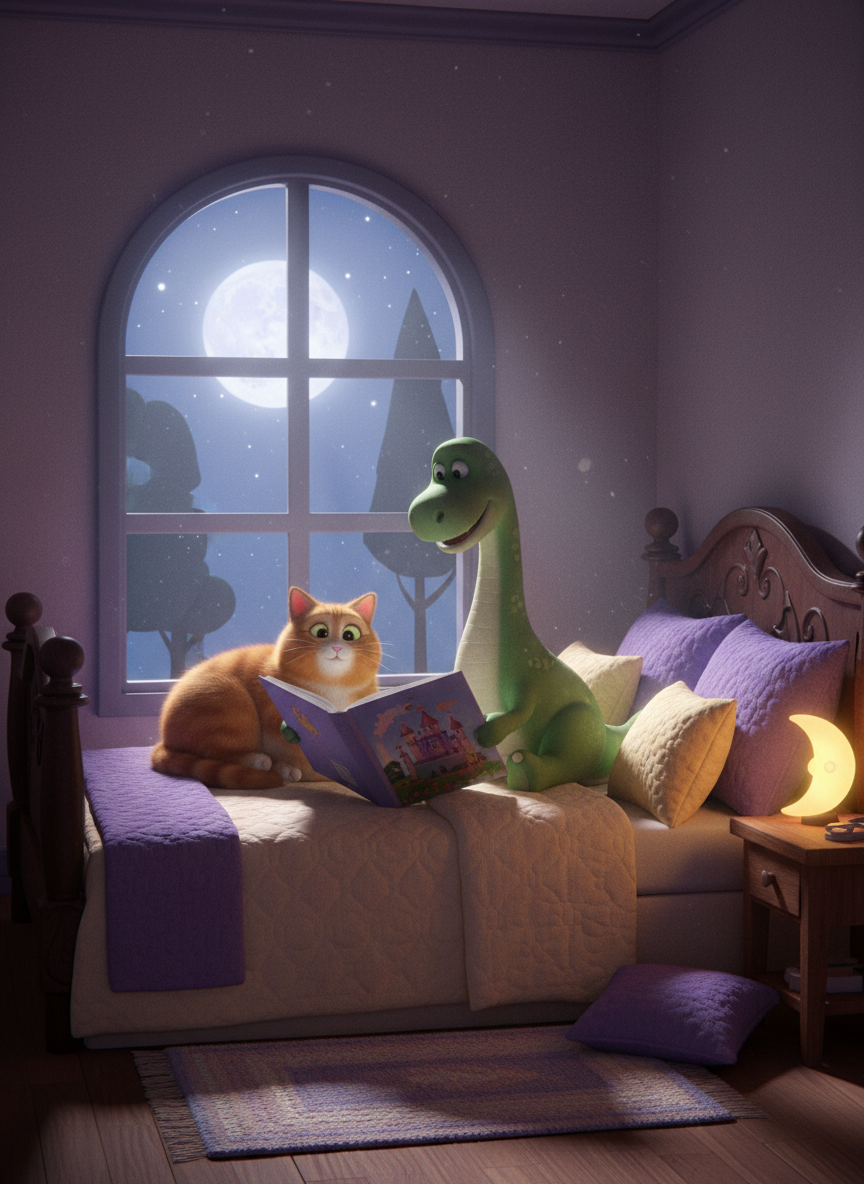
When Kitty and Dino settle in for their bedtime stories, they always find a cozy spot first — a special reading nook that signals “this is wind-down time.” The ritual of settling into the space is as important as the story itself.
2. Gentle Stretching
Children hold tension in their bodies just like adults. Gentle movement before bed releases it:
“Reach for the stars, touch your toes.” Simple, rhythmic movements that coordinate breath and body.
Child-friendly yoga poses. Cat-cow stretches. Child’s pose. Gentle twists. Nothing strenuous — just releasing the day’s physical stress.
The body scan. “Squeeze your toes tight, now let them go.” Working up the body, teaching awareness and release.
Keep it short — five minutes is plenty. The goal is not exercise; it’s embodied calm.
3. Breathing Together
Breathwork for children isn’t complicated. Two techniques work consistently:
“Smell the flower, blow out the candle.” Deep nasal inhale through a pretend flower, slow exhale through pursed lips. Simple, visual, effective.
The counted breath. Breathe in for 3, hold for 2, out for 4. The extended exhale activates the parasympathetic nervous system — the “rest and digest” response.
Balloon breathing. Place a small stuffed animal on the belly — watch it rise and fall like a balloon. This teaches diaphragmatic breathing naturally.
Do it together. A parent’s regulated breathing helps regulate a child’s. This is co-regulation in action.
People Also Ask: What are calming stories for kids?
Calming stories have slow pacing, gentle conflict, and satisfying resolution. They feature familiar characters in reassuring patterns. The language is rhythmic — not jarring or surprising. Nature themes work well: growing things, gentle weather, animals settling down for sleep. Avoid new characters, high-stakes adventure, or open-ended questions that invite thinking rather than drifting.
4. The Gratitude Moment
End the day with three good things. This isn’t just positive psychology — it’s a cognitive transition:
It shifts attention. From whatever went wrong during the day to what went right. The brain can’t hold both at once.
It creates safety. Acknowledging good things reinforces that the world is fundamentally okay, making sleep feel safe.
It extends connection. Sharing gratitudes is a final moment of togetherness before separation for the night.
Keep it simple. “What was your favorite thing today?” “What made you laugh?” “Who were you kind to?” Any small moment counts.
5. Creating a Sleep Cue
The final activity is environmental — creating sensory signals that sleep is coming:
Lower the lights. Dimming lights triggers melatonin production. Use a lamp instead of overhead lights for the last 30 minutes.
Cool the room. The body sleeps better when the temperature drops slightly. 65-68°F (18-20°C) is ideal.
White noise. Consistent background sound masks household noise and creates an auditory cue for sleep. Rain sounds. Ocean waves. A simple fan.
The special object. A stuffed animal that’s only for bed. A specific blanket. Something that lives in the sleep space and signals “this is where rest happens.”
Building the Routine That Works for You
Don’t try all five activities at once. Start with one — probably the story ritual — and add others gradually.
The sequence matters more than the specific activities. The brain learns: “First we do this, then this, then this, then sleep.” Predictability is the magic ingredient.
Sample routine:
30 minutes before bed: Dim lights, start story time
20 minutes before bed: Last story, cuddle time
10 minutes before bed: Gratitude moment, breathing
Lights out: Song, kiss, sleep
Adjust based on your child. Some need longer wind-down; others can move faster. The goal is calm, not rigid.
TL;DR — Screen-Free Bedtime That Works
- Remove screens — they stimulate when you need calm
- Start 30-45 minutes early — wind-down takes time
- Choose 2-3 activities — stories, stretching, breathing, gratitude
- Keep the sequence consistent — ritual signals sleep is coming
- Dim lights, cool room, white noise — environmental cues matter
The best bedtime routine is one you can do consistently. Start simple. Build slowly. What matters is showing up, night after night, with calm presence.
Looking for calming bedtime stories? Discover the Magical Tales of Kitty & Dino — gentle adventures perfect for winding down at the end of the day.